
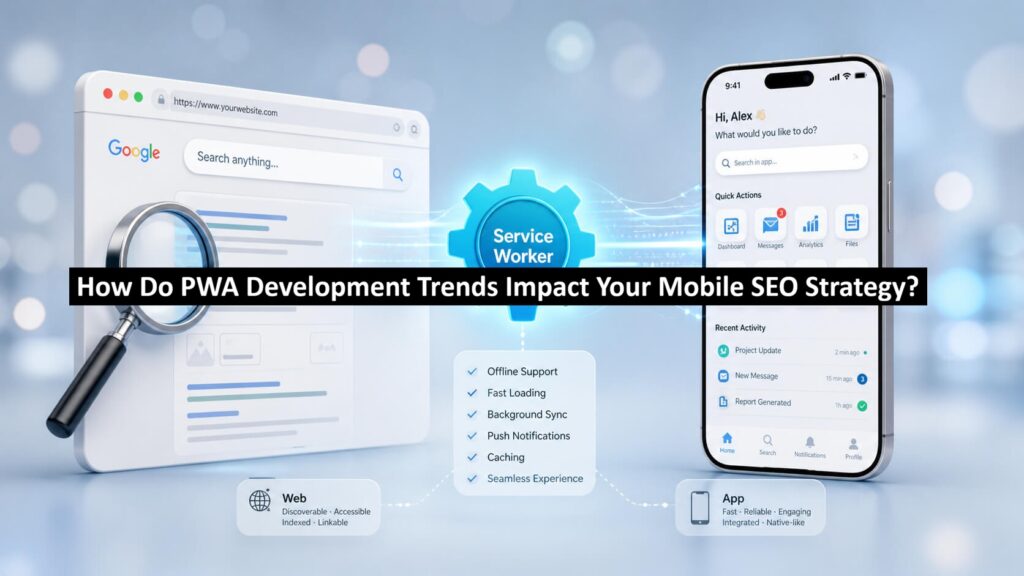

Today, having a mobile-friendly site isn’t just nice to have, it’s a necessity. With Google’s move to mobile-first indexing reaching its final stage; a good mobile site (responsive) vs. high-performance app is now the deciding factor for ranking.
Enter the Progressive Web App (PWA). PWAs combine the reach of the web with the high-performing experience of a native app, eliminating the friction that causes low conversions. By leveraging current trends in PWA development you will increase your chances of dominating SERPs and to improve your mobile strategy.
1. Mastering Core Web Vitals with PWA Architecture
The primary metrics for User Experience (UX) on mobile SEO are Google’s Core Web Vitals (CWV). These are the primary metrics to measure User Experience (UX) on SEO for mobile websites and are also necessary to rank on the first page.
PWAs have been architecturally designed to ace the above metrics by default.
- LCP (largest contentful paint): Modern PWAs use aggressive Service Worker caching to improve the overall experience by removing the “app shell” from the user’s device and caching all of the content on the device. The time to render your main content is reduced significantly because of this. As a result, many top-tier PWAs have LCP times of less than 1.2 seconds, far exceeding Google’s “good” standard for LCP.
- INP (Interaction to Next Paint): INP is now a ranking factor, and as such, your app needs to be responsive to improve your ranking. Because PWAs can use client-side logic to handle transitions, they eliminate the ‘white screen’ delay between pages and provide a fast/Responsive experience which will positively impact your INP score.
- CLS (Cumulative Layout Shift): Modern PWAs prevent ‘jumps’ when images load through the use of skeleton screens and aspect-ratio boxes. A stable user experience is a significant signal of quality to Google’s crawlers
Read: How to Ensure Reliable Communication Across Multiple Locations
2. The SEO Power of Service Workers: Beyond Offline Access
A PWA’s service worker is the magic ingredient that makes it work. The service worker can work in the background and be independent of the browser tab. Although many people typically think of the service worker in relationship to the PWA’s offline functionality, it has an innovative impact on how a PWA affects SEO.
Predictive Fetching
Predictive Fetching (PF) is an important new trend in today’s software and design field as it uses intelligent calculations to predict what the next link the user will click on and preloads the data for that link into memory for faster response times. This means when a user clicks on the link, the page will appear right away for them, resulting in what Google refers to as a “zero-latency” experience and considered to be a huge quality indicator.
Improved Time to First Byte (TTFB)
Reducing the load on an origin server helps improve TTFB by offloading repetitive tasks to a client-facing service worker. Consequently, search engine spiders can access your pages and index them more easily than if they were subject to rate limits.
3. Advanced Capabilities: AI Personalization and Project Fugu
Advanced Web Capabilities (aka Project Fugu), Edge AI (a.k.a., Edge Artificial Intelligence) are two key areas that will help redefine the mobile web by addressing some current trends in emerging technology around these two areas.
- The Impact of Project Fugu: Project Fugu will help bridge the gap between the web and native applications by offering Web developers and users access to their local file systems and hardware APIs. Providing these types of capabilities will drive users to spend more time on the web, which impacts search engine optimization (SEO) as dwell time is an important metric that signifies there is value in your content.
- The Integration of Edge Artificial Intelligence: The introduction of WebGPU will allow PWAs (Progressive Web Applications) to run AI models directly on the client side (i.e., user device), thereby allowing the developer to provide personalized experiences and/or functionality without relying on “JavaScript bloat” typically associated with server-side requests. This will create a leaner, faster website with much better indexability/reachability.
4. Technical Checklist: Ensuring Your PWA is Search-Friendly
A PWA that cannot be indexed by search engines is not a PWA at all. Therefore, if you want your PWA to maintain its search rankings, make sure that the web development company you hire follows all of these guidelines for how to implement SEO for PWA:
- Clean URLs: Use the HTML history API for all of your PWA pages. Do not use hash-bang (“#!”) URLs. This is the only way for every page on your PWA to have a unique and indexable URL by a search engine.
- Hybrid Rendering: Search engines prefer to see content served immediately through server-side rendering (SSR). Use hybrid rendering (SSR and Hydration) to create a static version of your PWA in HTML format when it is crawled by search engines, but provide a dynamic PWA experience for users.
- Web App Manifest: Make sure your manifest.json is fully optimized to help google understand your PWA as a high-quality app. This will increase the likelihood that your PWA will be shown in mobile search results.
- Canonicalization: Always use canonical tags to point your PWA pages to their canonical URL. This will help eliminate duplicate content issues between your mobile and desktop versions of your app.
5. Building E-E-A-T Through “Installability”
Google’s EEAT (Experience, Expertise, Authority and Trust) wants to look at your brand as an authority. In this scenario your authority as a brand is considered via the E-E-A-T guidelines if you have impacted users of your PWA once they add your PWA to their home screen.
Once a user adds your PWA to their home screen they will be classified as a “Loyalist.” These loyalists contribute to:
- More Direct Searches for Your Brand: When users have your icon on their home screen, they search directly for your brand more often versus searching via Google Search.
- More Direct Visits: When you are regularly engaging with users via their home screens, Google’s indication is you are an authoritative brand within your niche.
- More Engagement via Push Notifications: When you leverage push notifications from your PWA appropriately, you can improve your user interaction data through repeat site visits and therefore improve the “freshness” of your user interaction data.
Conclusion
Incorporating a PWA (Progressive Web Application) into your mobile SEO strategy has become essential. All current search results will reward those websites that are running at optimum speeds, are highly reliable and demonstrate brand authority – the exact qualities that define a Progressive Web Application. This is accomplished by using Service Workers, mastering the fine art of JavaScript Search Engine Optimization and developing an “installable” web experience; this way you have positioned your brand to take advantage of the growing mobile marketplace.
Author Bio:
Akshay Tyagi is a technical writer at NetClubbed, where he explores the intersection of progressive web technologies and search visibility. Representing a leading web development company in Noida, he provides actionable insights into how modern PWA frameworks drive mobile-first indexing success and user engagement.